Public replay shape map#
Replay outcome |
Fixtures |
Mark |
|---|---|---|
Uniquely resolved |
44 |
Teal circle |
No match |
11 |
Orange square |
Ambiguity refusal |
1 |
Rose diamond |
Unreplayable |
3 |
Gray triangle |
Total |
59 |
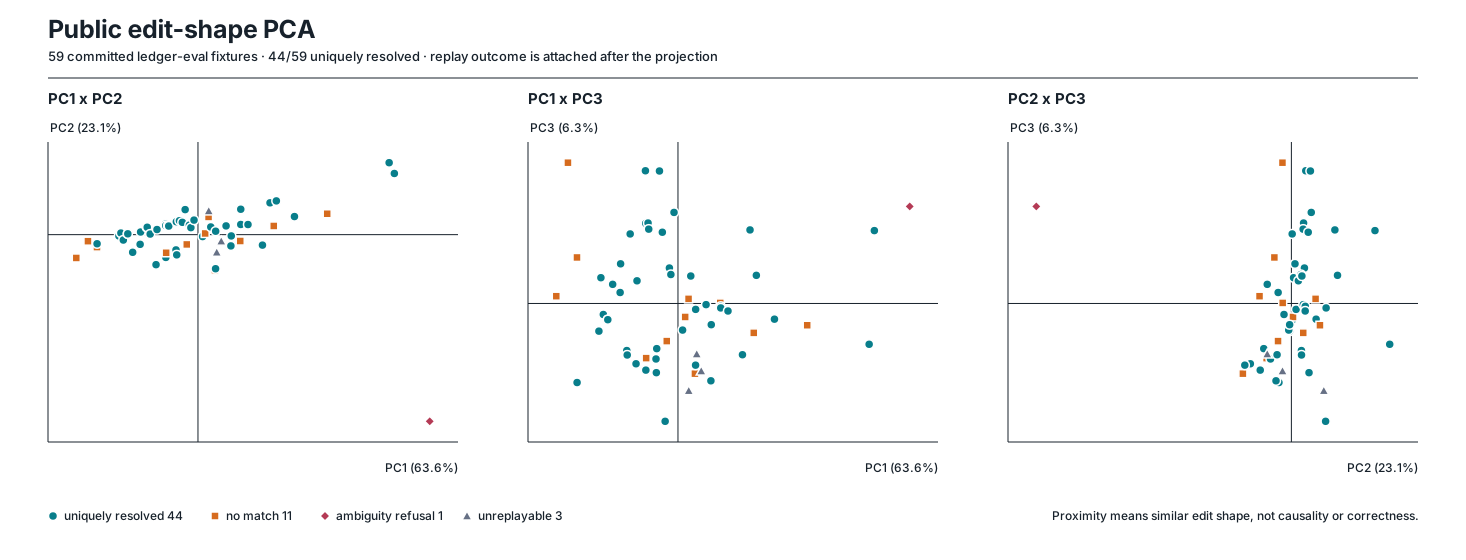
This is a compact, reproducible view of the committed public public ledger_eval fixture corpus corpus.
It replaces the former mixed-population error cloud.
The old figure combined live agent lifecycle data, private fixture-derived material, and expanded local telemetry, then made a token-savings claim.
That claim and that population are retired: this figure is only a public-fixture replay benchmark.
What is projected#
The generator replays all 59 committed JSON fixtures with the current reconciliation ladder, then derives a six-column numerical matrix from edit shape:
Feature |
Meaning |
|---|---|
|
Size of requested old and new text |
|
Old and new text line counts |
|
Absolute character-size change |
|
Relative expansion or contraction of the edit |
The columns are centered and scaled before PCA.
Outcome, family, rung, category, case ID, all label-like codes, and snapshot measurements are excluded from that matrix.
A missing snapshot defines unreplayable, so zero-imputing its size would leak the display outcome into PCA.
Only after PCA does the graphic attach replay outcome as a color-and-shape label.
Axis labels give the explained-variance ratio for each principal component.
The generated JSON includes loadings for PC1–PC3: these are the standardized feature weights that make a component interpretable.
Compare absolute loading sizes, not signs; PCA component orientation is arbitrary.
The explained_variance_ratios list records how much standardized edit-shape variation each displayed component accounts for.
Proximity means similar edit shape, not causality or correctness. The triptych avoids a synthetic camera or depth ordering: it shows PC1 x PC2, PC1 x PC3, and PC2 x PC3 directly.
Replay and safety boundary#
“Uniquely resolved” means the public replay found one match under the current ladder. “No match” and “ambiguity refusal” are distinct structured outcomes; the latter is an intentional refusal to guess. “Unreplayable” means the committed fixture lacks a captured file snapshot, not that the ladder crashed.
The constrained same-intent comparison finds 0 candidates among 9 checkable same-intent pairs. It compares only fixtures whose later follow-up is both resolvable and highly similar enough to plausibly represent the same logical edit. This is not a claim of zero production false heals, nor does it cover fixtures without checkable follow-up ground truth.
Provenance, privacy, and reproduction#
error-cloud.json is schema tact.ledger-eval-shape-pca version 3.
It binds the exact public fixture population to a deterministic SHA-256 manifest, records feature names, PCA variance/loadings, aggregate replay counts, and anonymous outcome/rung/PC coordinates.
It deliberately carries no case IDs, file paths, file extensions, old/new strings, snapshots, follow-ups, notes, families, or categories.
Regenerate the tracked JSON and SVGs from repository inputs:
uv run python scripts/build_error_cloud.py
Confirm that all generated files are current without changing them:
uv run python scripts/build_error_cloud.py --check
The generator depends only on the stdlib plus this repository’s tact.eval replay module.
It does not inspect local telemetry, sessions, private corpora, network services, timestamps, or randomness, so repeated generation from unchanged repository inputs is byte-identical.